A landmark publishing event for practitioners, policymakers, and leaders navigating the economic and governance consequences of AI at scale – now available globally in eBook format.
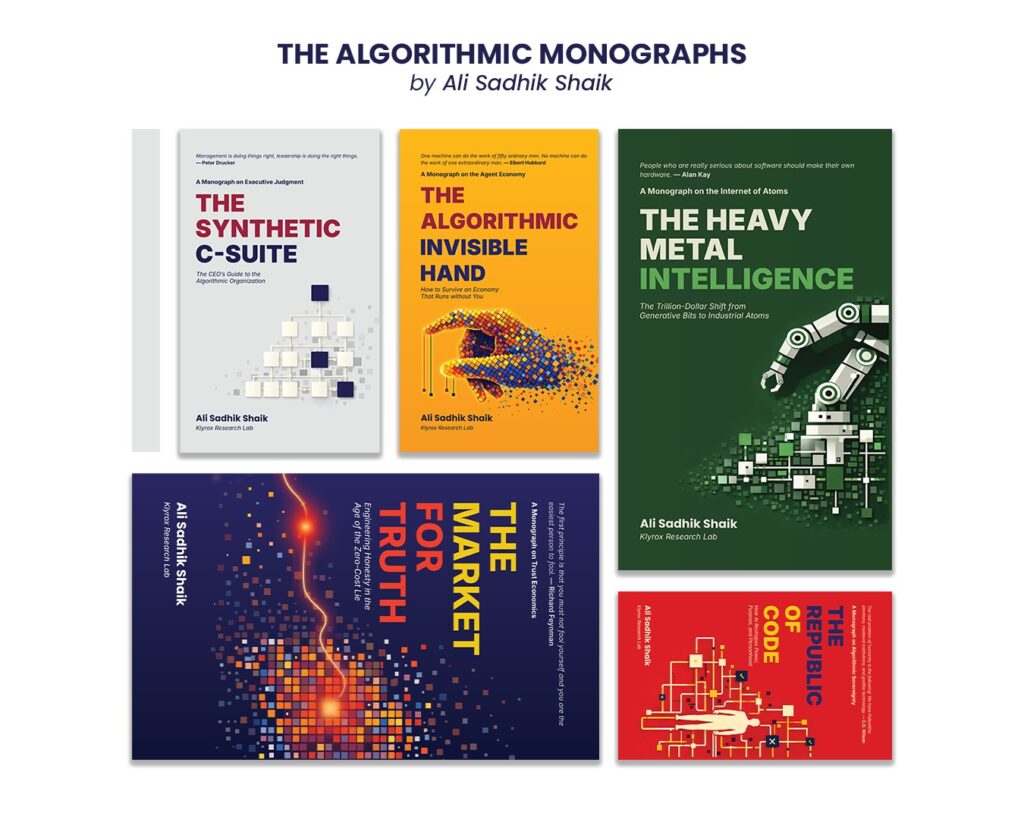
Bengaluru, India – Klyrox Research Lab today announces the global release of The Algorithmic Monographs – a definitive five-volume series authored by Ali Sadhik Shaik, a veteran product executive and protocol architect with nearly two decades of experience building systems at the intersection of markets, technology, and trust.
 The series arrives at a critical moment. Artificial intelligence is no longer a productivity tool – it is becoming the operating system of the global economy. Algorithms are pricing assets, governing platforms, executing contracts, and making decisions that once required human judgment. And yet the frameworks we use to understand, govern, and lead through this transition remain largely unchanged since the industrial era.
The Algorithmic Monographs is an attempt to change that. Written for leaders, builders, and policymakers – but grounded in economic theory, institutional analysis, and mechanism design – the series maps the consequences of this transition across five domains: markets, governance, truth, power, and organizations.
|
The Algorithmic Monograph on Amazon Kindle | Google Books | Lean Pub
The Series: Five Volumes, Five Domains
Each volume in the series stands alone as a complete work – with its own argument, its own evidence base, and its own prescriptions for action. Together, they form a unified framework for understanding and navigating the autonomous age.
| The Algorithmic Invisible Hand
How to Survive an Economy That Runs Without You Adam Smith’s Invisible Hand assumed human actors making self-interested decisions in markets. The first volume of the Monographs asks what happens when those actors are algorithms – faster, cheaper, and operating at scales no human institution can match. Drawing on classical economics and modern mechanism design, this volume maps the structural shifts underway in labour, capital allocation, and competitive dynamics as machine-to-machine commerce becomes the norm. It is not a warning – it is a navigation guide for those who intend to remain relevant in an economy increasingly governed by code. |
| The Republic of Code
How AI Reshapes Power, Purpose, and Personhood Institutions derive their authority from a combination of legitimacy, enforcement capacity, and collective belief. Algorithms are now competing with traditional institutions on all three dimensions – governing platforms, enforcing contracts, and shaping identity at scale. Volume IV examines this as a political and philosophical question as much as a technical one. What happens to sovereignty when code can govern more efficiently than law? What does accountability mean when the decision-maker is a model? And what does it mean to be a person – with rights, obligations, and a stake in the systems that govern your life – in a world where those systems are increasingly autonomous? Essential reading for policymakers, governance researchers, and anyone thinking seriously about digital rights. |
| The Market for Truth
Engineering Honesty in the Age of the Zero-Cost Lie When the marginal cost of generating false information drops to zero, the economics of truth collapse. This is not a future scenario – it is the present reality of synthetic media, AI-generated content, and algorithmically amplified misinformation. Volume III frames this as an economic problem, not a moderation problem. Drawing on information economics, mechanism design, and the history of financial markets, it argues that the solution to the information crisis is not better filters – it is better incentives. A rigorous, practical examination of how markets for credibility can be designed, governed, and sustained at scale. |
| The Heavy Metal Intelligence
The Trillion-Dollar Shift from Generative Bits to Industrial Atoms The first wave of AI created value in software – in bits. The second wave is moving into the physical world – into industrial systems, supply chains, energy infrastructure, and manufacturing. This volume traces that transition and its implications for capital allocation, geopolitical competition, and industrial policy. It argues that the organisations and nations that will define the next century are not those with the best language models – but those that successfully integrate machine intelligence into physical infrastructure. A strategic roadmap for leaders operating at the intersection of deep tech and the real economy. |
| The Synthetic C-Suite
The CEO’s Guide to the Algorithmic Organization Leadership in the autonomous age is not about understanding AI – it is about knowing what to delegate to it and what to protect from it. Volume V is a practical guide for senior executives navigating the transition from traditional organizational models to hybrid human-AI systems. Drawing on two decades of operator experience across B2B SaaS, fintech, and Web3, the author maps the new competencies that define effective leadership when cognitive tasks are increasingly automated: judgment under ambiguity, curation over creation, governance over execution. The Centaur Model – human and machine operating in genuine partnership, each doing what they do best – is the organizing framework for this volume and for the series as a whole. |
Why This Series. Why Now.
The business and policy literature on AI has tended toward two extremes: breathless optimism about productivity gains, or existential alarm about superintelligence. The Algorithmic Monographs occupies a different position – it takes the near-term economic and governance consequences of AI seriously, without either dismissing the disruption or catastrophising it.
The series is written by a practitioner who has spent two decades building the kinds of systems the books describe – marketplaces, decentralized infrastructure, AI-native products – and who has encountered the governance failures, incentive misalignments, and trust deficits that the theory predicts. The result is a body of work that is analytically rigorous without being academic, and practically grounded without being superficial.
Each volume is supported by published academic working papers currently being prepared for submission to peer-reviewed journals, and by a body of technical research available open-access on Zenodo.
|
Who the Series Is For
The Algorithmic Monographs is written for five distinct audiences – each of whom will find different volumes most directly relevant to their work:
| Audience | Most Relevant Volumes |
| Senior Executives & CEOs | Volume V (The Synthetic C-Suite), Volume I (The Algorithmic Invisible Hand) |
| Policymakers & Regulators | Volume II (The Republic of Code), Volume III (The Market for Truth) |
| Investors & Venture Operators | Volume I, Volume IV (The Heavy Metal Intelligence) |
| Product Leaders & Builders | Volume V, Volume III, Volume I |
| Academics & Researchers | All five volumes, with supporting working papers on Zenodo |
About the Author
Ali Sadhik Shaik is a product executive, protocol architect, and researcher with nearly two decades of experience scaling B2B SaaS, fintech, and Web3 platforms. He is currently Senior Vice President of Product and Market Strategy at Astrikos AI, and the Founder of Web3Wire.
An incoming Doctoral candidate at Golden Gate University, USA – researching AI governance and accountability frameworks. His academic background spans an MBA from Edith Cowan University, programs at UT Austin, IIM Indore, ISB, and Emeritus in collaboration with MIT Sloan and Columbia. He is a Certified Independent Director, a practitioner of Stoicism, and a dedicated Notaphilist. He lives in Bengaluru with his wife Sameena and two daughters.
Availability
The Algorithmic Monographs (Volumes I–V) are available globally in eBook format:
| Amazon Kindle | https://www.amazon.com/dp/B0GN8JWCHY |
| Google Books | https://play.google.com/store/books/series?id=GSqYHAAAABCANM |
| LeanPub | https://leanpub.com/b/the-algorithmic-monographs |
| Supporting Research | https://zenodo.org/records/18729968 |
| ORCID | orcid.org/0009-0004-8347-083X |